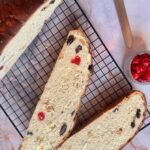
Norwegian Julekake Recipe
A holiday takes on sweet bread, this Julekake looks impressive, but it is completely achievable in your home kitchen. Made from rich dough spiced with cardamom, filled with nuts, sultanas, and currants, and washed with egg for a deep golden-brown color, this traditional Norwegian Christmas bread is a must-try.
Servings 1 loaf
Calories 3009kcal
Ingredients
- 1 and ¼ cups (280 ml/g) whole milk, warmed to about 110°F (43°C) about
- ½ cup (100 grams) granulated sugar
- 1 teaspoon (3 grams) ground cardamom
- 2 and ¼ teaspoons (7 grams) instant or active dry yeast
- 1 medium egg
- 4 cups (480 grams) bread or all-purpose flour, plus more as needed
- 1 and ½ teaspoon (9 grams) sea salt
- ¼ cup (56 grams) unsalted butter, at room temperature
- ¾ cup (120 grams) blanched almonds
- ¾ cup (120 grams) sultanas golden raisins
- ¾ cup (120 grams) currants black raisins
- ¾ cup (120 grams) dried cherries
- For washing: 1 beaten egg
Instructions
- Prepare the dough: In the bowl of your stand mixer fitted with the dough hook attachment, whisk together the warm milk, sugar, and cardamom. Add the yeast and whisk to combine. Cover the bowl and let the mixture rest for 10–15 minutes, or until it turns foamy and frothy on top.
- Stir in the egg, then add the flour and salt. Beat on low speed for about 4 minutes until the dough comes together. Pause to scrape down the sides of the bowl with a silicone spatula or bowl scraper to ensure everything is fully incorporated. By the end of this step, the dough should pull cleanly away from the bottom of the bowl and gather around the dough hook. If it doesn’t, add 1 tablespoon of flour at a time until it does. Avoid adding more flour than necessary—you don’t want a dry dough.
- Knead the dough: Switch the mixer to medium speed and knead for 5–6 minutes, stopping twice to scrape the dough hook so everything kneads evenly. If the dough becomes too sticky and clings to the bottom of the bowl, add 1 teaspoon of flour at a time until it forms a soft dough. Don’t add more flour than necessary—you want a supple dough, not dry dough. The dough is ready when it’s soft, smooth, and elastic. Gently press it with your fingertip; if the dent slowly springs back, you’re ready to move to the next step. If not, knead in 1-minute intervals and test again. You can also use the windowpane test here.
- Incorporate the fat: Switch the mixer back to low speed. Add the butter one piece at a time, waiting for each piece to fully incorporate into the dough before adding the next. This takes about 2–3 minutes. If you see butter clinging to the sides of the bowl, stop and scrape it down (New to enriched dough? See my Master the Science of Enriched Dough guide for tips). Once all the butter is incorporated, continue mixing on low for another 3 minutes. The dough should look smooth, supple, and lightly sticky.
- Lightly flour your work surface and turn the dough onto it. Stretch the dough into a 10x25-inch rectangle (they don't have to be perfect). Sprinkle the blanched almonds, sultanas, raisins, and dried cherries on top. Fold the edge onto the center, and gently turn the dough so the fruit and nuts stick throughout.
- 1st Rise: Lightly grease a large bowl with butter or non-stick spray. Shape the dough into a ball. Place it in the bowl and turn it to coat all sides. Cover the bowl tightly and allow the dough to rise in a relatively warm environment until doubled in size, about 90-180 minutes. Enriched dough rises slowly—be patient.
- Line a half sheet pan with parchment paper, or lightly grease it with nonstick spray or butter.
- Shape the bread: Once the dough has risen, gently punch it down to release the air. Lightly flour your work surface and hands. Turn the dough out onto the work surface and shape into a 7-inch round loaf. Place it on the prepared baking sheet.
- 2nd Rise: Loosely cover the shaped Julekake dough. Allow to rise in a relatively warm environment until it reaches about a 9-inch round ball, at least 60–90 minutes.
- Preheat the oven to 340°F (170°C).
- Lightly brush the risen bread dough with a beaten egg.
- Bake the bread: Bake for 30–35 minutes, or until the top is a deep golden brown. The top of Julekake bread browns quickly, so I recommend loosely tenting it with aluminum foil or parchment and rotating the baking sheet halfway through.
- Remove from the oven and immediately place the hot bread in a wire rack. Allow to cool at least 30 minutes before slicing and serving.
- Cover leftover Julekake tightly and store in a plastic bag at room temperature for 3 days, or in the refrigerator for up to 1 week.
Notes
The temperature when I made this recipe: 53 Fahrenheit (12 Celsius).
Overnight Instructions: Prepare the dough through step 5. Place the dough into a greased bowl, cover it tightly, and put it in the refrigerator for up to 24 hours; when you are ready to continue, remove the dough from the refrigerator, let it reach nearly room temperature, then shape it and allow it to rise again before you brush it with an egg wash and bake it.
Freezing Instructions: You can freeze the Julekake in two ways: for a baked loaf, wrap the completely cooled loaf tightly in plastic wrap, then with aluminum foil, and store it in the freezer for up to 3 months; thaw the wrapped loaf overnight in the refrigerator or at room temperature, then unwrap and warm it in a hot oven. Alternatively, you can freeze the unbaked dough after you add Mix-ins in step 5, wrap the dough tightly in plastic wrap, and freeze it for up to 3 months, then thaw it overnight in the refrigerator, punch the dough down to release any air bubbles, and continue with the next step.
Special Tools (affiliate links): Kitchen Scale with Liquid Measuring Cups / Measuring Cups & Spoons | Stand Mixer | Silicone Spatula / Bowl Scraper | Bench Scraper | Baking Sheet | Pastry Brush | Wire Rack.
Flour: You can use either bread flour or all-purpose flour for this recipe, but note that all-purpose flour may require a longer kneading time to achieve full gluten development.
Mix-ins options: For various Mix-ins, refer to the blog post above. Note that you add any mix-ins after you incorporate the fat in step 5.
